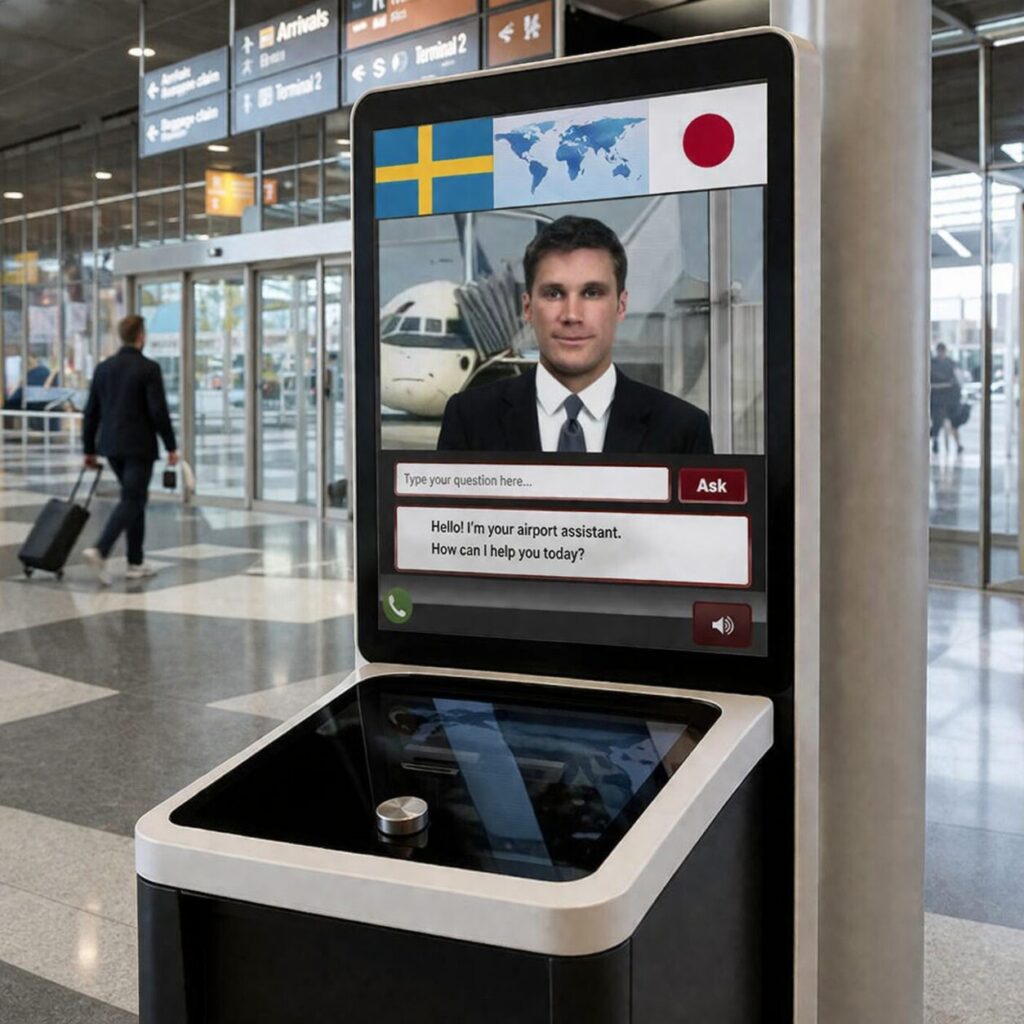
The Challenge
An airport technology company had built an AI wayfinding and information assistant. European pilots showed strong usability scores, but early feedback from Japanese airport partners flagged discomfort with the assistant’s direct communication style, proactive suggestions, and recovery phrases after misunderstanding.
Approach and Execution
I ran a comparative UX study across Swedish and Japanese airport staff and frequent flyers using Wizard-of-Oz prototypes. The study mapped cultural dimensions (Hofstede’s uncertainty avoidance, power distance, individualism) to specific conversational patterns — hedging language, initiative level, formality register, and error recovery scripts.
Results
Key Insight
The most impactful single change was re-framing the assistant’s error recovery. In the Swedish version it was direct: ‘I didn’t understand that — could you rephrase?’ In the Japanese version it became: ‘I want to make sure I help you correctly — could we try a different way?’ Same function, very different reception.
Outcome
The redesigned assistant was deployed at two Japanese airports and received 91% positive comfort ratings in post-deployment surveys. The cultural localization framework was documented as an internal design standard for future markets.
LLM · Prompt Engineering · Wizard-of-Oz Testing · UX Research